How to See Like a Machine
Tools for reading Trevor Paglen's book (Verso, 2026) by running the machines it describes, chapter by chapter. Each one asks of an image not what it says, but what it does.
Introduction
Every sensor is a set of lenses and blindfolds, an Umwelt. Paglen's studio built a framework called Chair to look through a machine's. He proposes asking what images do rather than what they represent.
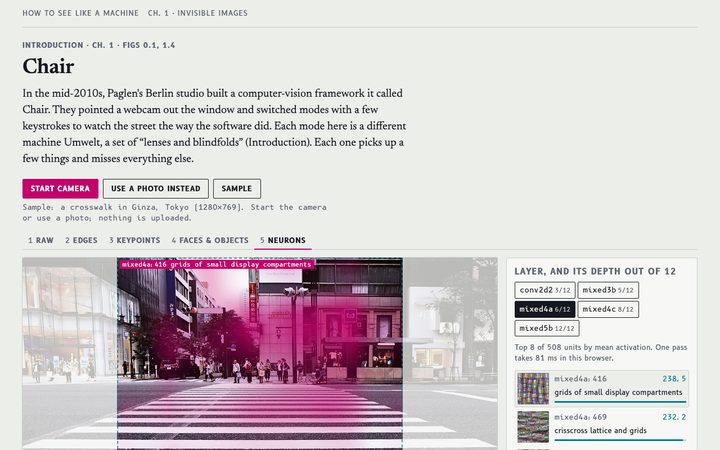
The Chair tool in Chapter 1 is this chapter's opening scene: a webcam switched between machine ways of seeing.
- One image, many UmweltsThe same photo read by a classifier, a detector, a depth model, a segmenter and a captioner, side by side.
- Descriptor matcherSIFT keypoints matched between two views of a mountain, after Paglen's Matterhorn (Fig 0.1).
Invisible Images (Your Pictures Are Looking at You)
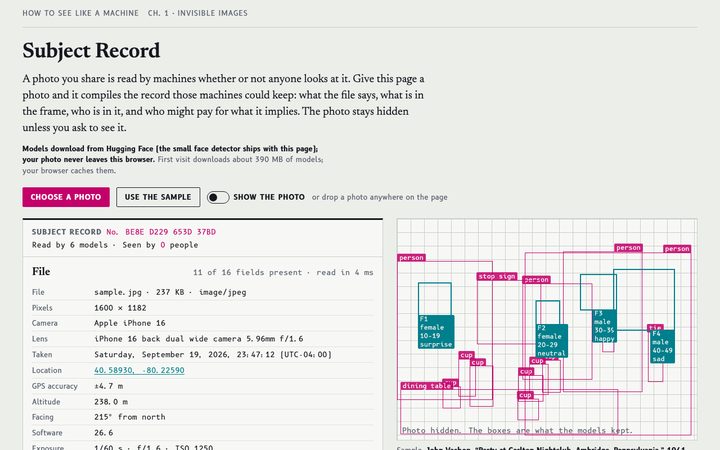
Most images are now made and read by machines, with no person in the loop. A shared photo becomes a metadata signature that insurers, police and platforms can act on.
-
-
-
-


- EigenfacesThe mean face and its components from public-domain portraits, after "Fanon" (Even the Dead Are Not Safe) (Fig 1.3).
- The image as the machine keeps itReduce a photo to its metadata, discard the pixels, regenerate an image from what's left.
Machine Realism: This Is an Apple
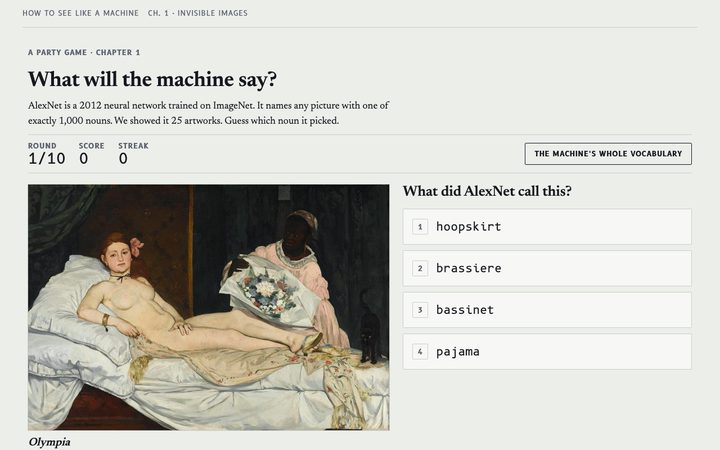
A training set is a taxonomy, classes and images, with politics at every layer. ImageNet took WordNet's nouns wholesale, including its categories of people.
- Taxonomy walkTrace ImageNet's classes up WordNet's hierarchy and chart where they sit.
- Ceci n'est pas une pommeWrite words on real apples and see which models read the text and which see only fruit.
- Seven emotions, performedAn expression classifier on yourself acting out the seven JAFFE categories.
Machine Realism: This Is Not an Apple
Magritte insists a picture of an apple is not an apple; the classifier insists it is. That literalism works where factories and policing have already made the world uniform.
- Ambiguity collapseMorph an apple into a tomato into a ball and watch the classifier always pick a winner.
- The quality-control lineA tiny sorter for "eating apples"; feed it heirlooms, bruises and Cézanne.
- Physiognomy machineCLIP asked to read character from public-domain portraits. It always answers.
Neural Activations
From Hubel and Wiesel's kittens to GANs: images as stimuli that trigger neurons, in networks and in us. Media engineered like a snack food for the visual cortex.
- Blakemore's kitten, in silicoTrain a small network on a world without vertical lines, then show it one.
- Machine pareidoliaFace detectors on clouds, toast and the Cydonia "face on Mars" (Fig 4.5), then noise optimized until one fires.
- Mind DoritosImages optimized against an aesthetic predictor until they become superstimuli.
- Adversarial perturbationsInvisible changes that flip a classifier, and a test of whether they nudge us too.
Society of the Psyop
UFO hoaxes, CIA magicians, ELIZA and electronic warfare as ancestors of media that watch our reactions and adjust themselves to them. Three parts.
- Bledsoe's standard head1960s face recognition by landmark distances (Fig 5.7) against a modern embedding.
- The ELIZA effectWeizenbaum's 1966 script, an LLM and a person, in a blind test.
- PalladiumOne image that reads as a different object to each model looking at it.
- The importance of feedbackA generate, score, mutate loop that amplifies what its audience already believes.
The Archives of the Future
AI images keep photography's look and lose its tie to the world. Every picture becomes a UFO photo, settled by belief rather than evidence.
- Everything is a UFO photographReal and generated UFO pictures judged by detectors, a VLM and the club.
- The VoiceOne ambiguous image captioned under different framings: hoax, evidence, miracle.
- Indexicality as styleWhich photographic codes (grain, flare, blur) make a machine call an image real.
Conclusion
Ask what an image does. Platforms measure our responses and tune what we see, so consuming media becomes training data for the system that serves it.
- All media consumption is RLHFA simulated feed that learns from dwell time and narrows toward what activates.